
When a brand spends upwards of $17 million on a single 60-second commercial, every creative and strategic choice matters. BMW’s 2024 Super Bowl campaign, “Talkin’ Like Walken,” is more than just a celebrity-powered TV spot — it’s a compelling case study in modern ad production, media investment, and cultural relevance. From the casting of Christopher Walken and Usher to high-gloss direction by Bryan Buckley, the ad was built to generate conversation across platforms. In this breakdown, we explore what made the campaign so expensive — and why, from an advertiser’s perspective, the spend was fully justified.
Super Bowl
BMW’s spot aired during Super Bowl LVIII on February 11, 2024, broadcast nationally on CBS. This year’s Super Bowl drew over 123 million viewers, making it the most-watched telecast in U.S. history.
The 60-second commercial aired during the first quarter, a strategic position often chosen by major advertisers to maximize attention before viewer fatigue or halftime distractions. In 2024, the average rate for a 30-second Super Bowl slot was approximately $7 million, meaning BMW’s 60-second buy cost around $14 million in airtime alone.
Creative Credits – BMW “Talkin’ Like Walken” (Super Bowl 2024)
- Director: Bryan Buckley (Hungry Man)
- Director of Photography (Cinematographer): Hoyte van Hoytema
- Executive Producers (Production Company – Hungry Man): Margo Mars, Hank Perlman
- Creative Agency: Goodby Silverstein & Partners (GS&P)
- Lead Actor: Christopher Walken
- Cameo Appearance: Usher
- Color Grading: Company 3
- Mix Engineer / Sound Design: Steve Rosen, Kelly Oostman
- Audio Post Producer: Justine Cortale
- Senior Broadcast Producer: Daniel Chang
- VFX / Finishing: The Mill
- Client: BMW of North America
Background: The Product and Brand Objective
BMW launched the all-electric i5 sedan as part of its broader push toward sustainable mobility. Positioned at the intersection of innovation, luxury, and performance, the i5 competes with Tesla, Mercedes EQ, and Audi e-tron. For its U.S. introduction, BMW selected the 2024 Super Bowl — one of the most expensive and high-impact global promotion channels — as the platform to deliver maximum brand exposure and cultural resonance.
Campaign Investment Breakdown
| Component | Estimated Cost (USD) | Purpose |
| Super Bowl media slot | $14 million (source) | Massive reach and cultural impact |
| Production | $5–6 million | High-gloss cinematic quality |
| Actors | $1–2 million | Emotional engagement, memorability |
| Total Estimated Budget | $17–20 million |
Integrated Marketing Communications (IMC) strategy
The American Marketing Association defines integrated marketing communications (IMC) as “a planning process designed to assure that all brand contacts received by a customer or prospect for a product, service, or organization are relevant to that person and consistent over time.” (Kotler & Keller, Marketing Management, 14th ed., Ch. 17, p. 495)
BMW’s “Talkin’ Like Walken” campaign exemplifies a well-executed Integrated Marketing Communications (IMC) strategy. The brand delivered a consistent message across all channels, positioning the i5 as original, smooth, and culturally iconic. The Super Bowl ad served as the central storytelling piece, supported by extended YouTube content, coordinated social media engagement, and wide press coverage in major outlets like Ad Age and Variety. The cameo from Usher created a tie-in with the halftime show, enhancing cultural relevance. Through strategic use of paid, owned, and earned media, BMW maximised impact, built brand equity, and aligned every customer touchpoint with its core identity.
BMW extended the campaign through:
- Owned media: BMW’s YouTube, website, and email assets
- Earned media: Coverage from Ad Age, Variety, LA Times, and others
- Social media: Twitter/X buzz, YouTube virality, and TikTok remixes
- Event synergy: Usher’s appearance as halftime performer amplified relevance
Casting & Roles
The casting strategy balances star power, performative precision, and cultural range. Each role was designed not for fame, but for function — to reinforce the idea that while many try to imitate, there is only one Walken. That metaphor directly supports BMW’s brand position: “accept no substitutes.”
Christopher Walken is the core creative anchor. The campaign revolves around the concept of mimicry and originality. Walken’s voice, cadence, and cultural imprint are instantly recognizable. That makes him an ideal symbol for a product that wants to be positioned as iconic and unmistakable, like BMW’s i5. He plays himself, but with restraint. That reversal (everyone else mimicking him) becomes the comedic engine.
Supporting actors — particularly the valet, barista, tailor, and waiter — are chosen for their ability to deliver believable yet exaggerated Walken impressions. Casting actors with this vocal precision and comedic restraint was essential to avoid tipping the ad into parody. Each character acts as a mirror to Walken — reinforcing his uniqueness while keeping the humor grounded.
The valet scene is structurally important. It’s the first impression and sets the tone. That actor had to land the timing, voice, and expression with clarity and without overacting — which he does. It establishes the rule of the world: this is a space where everyone knows Walken, and where Walken is increasingly out of place in his own image.
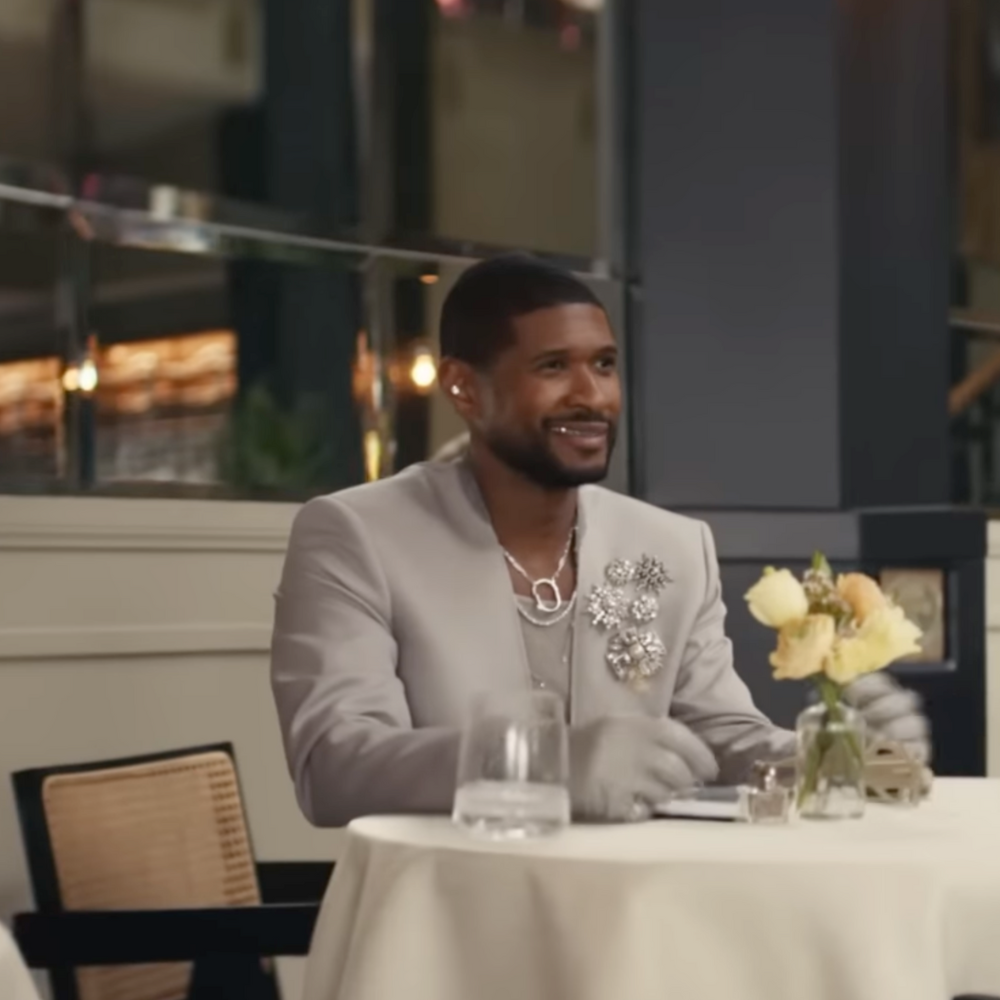
Usher’s cameo serves a different role: cultural tether. He connects the campaign to the Super Bowl halftime show, giving the ad relevance beyond its own frame. Usher was the Super Bowl LVIII halftime performer. Including him in BMW’s ad — even in a quick cameo — instantly ties the brand to the broader event, not just the commercial break. It’s a cultural handshake between BMW and the Super Bowl’s entertainment core.
Ashley Park’s appearance, while brief, introduces a generational contrast. It’s a subtle nod to younger audiences — she’s culturally fluent, fast-rising, and adds an additional layer of credibility in entertainment-adjacent spaces (like TikTok and streaming).
Music & Soundtrack
The ad opens with a cinematic orchestral cue — tonal, moody, and tightly scored. It sets up a dramatic space that frames Christopher Walken as a lead character in a prestige series. This isn’t filler music; it’s structural. It signals the tone, pace, and scale of the ad from the first frame.
When Walken meets the valet, there’s a deliberate pause in the music. That silence is functional — it isolates the mimicry, lets the voice impression land clean, and introduces the concept of authenticity vs imitation. Right after, the score pivots: a tight jazz-soul groove drops in with light rhythm section, brass accents, and syncopated phrasing. It lifts the scene but doesn’t oversell. It carries momentum across cuts while staying behind the dialogue.
As Walken moves through scenes — tailor, café, city street — the jazz cue acts like a tracking layer. It locks the pacing and adds tonal consistency across unrelated locations. When he enters the restaurant, the music cuts again. That drop is intentional — it opens space for the punchline and introduces a new phase. The track returns at the end, re-establishing thematic identity and closing the spot.